

 Euro (EUR)
 USA (USD)
 AUD (AUD)
 CAD (CAD)
 UK (GBP)
 Chinese Yuan (CNY)
 Hong Kong Dollar (HKD)
 Swedish Krona (SEK)
 South African Rand (ZAR)
 Norwegian Krone (NOK)
 Israeli New Sheqel (ILS)
 Brazilian real (BRL)
 United Arab Emirates dirham (AED)
 Swiss franc (CHF)
Written by Maksim
About Japanese natural stone fineness, flakes, and why hardness is the only number that matters
Many times customers ask me — what is the grit of this stone ? They want the finest stone for their razor or knife and try to compare Jnats to synthetic stones using grit numbers. This is a very wrong way to think about Japanese natural stones in general !!!
Let me explain why.
Flakes, Not Grit
Japanese natural stones do not have grit like we see in synthetic stones or even some other natural stones. Instead, they have flakes. These flakes release at different rates depending on how hard or compact the stone is — harder stones release flakes at a slower rate than softer stones.
Unlike synthetic particles which break off in large non-friable chunks, Jnat flakes continue to break down in thickness and size as the slurry is worked on the stone. The harder the stone, the smaller the flakes produced and at a slower rate. This slow release of smaller friable flakes produces a finer finish.
This is also why it is so important to flatten and completely smooth your Jnat finisher. Because no matter how hard the stone is — if the surface is left coarse, it will produce bigger flakes. Bigger flakes mean a less fine finish !!!
Synthetic Stones vs Jnats — Why They Feel So Different
If you take synthetic stones, the particles are cubed or rounded with extremely sharp edges. These particles deeply gouge into the blade being sharpened, leaving deep and difficult to remove scratches. Synthetic stone grit is also super-compressed into a hard resin or ceramic binder — the particles break off in huge, non-friable chunks and stay suspended in the slurry as you sharpen. This gives you very fast metal removal, but also the deep gouging you find with synthetics.
Jnat flakes work the opposite way — they shave off the metal in tiny amounts leaving very shallow scratches. To really understand this you would need to see the scratches in 3D, which is not possible in pictures. But you can feel the difference clearly when you use both types on the same knife.
Microscope comparison — synthetic particles vs Jnat flakes:
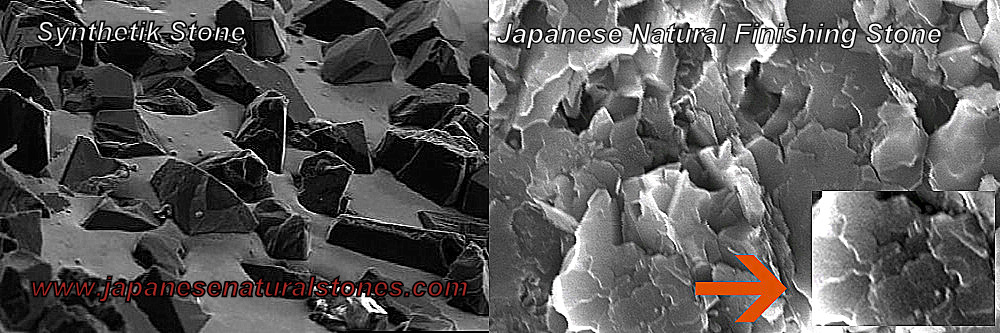
Synthetic stone particles (left) vs Jnat flakes (right) under microscope. The difference in shape and how they interact with steel is clearly visible.
Jnat Slurry — Before and After
These pictures show Jnat slurry under a microscope — pure fresh slurry on the left, and worked slurry after sharpening for a while on the right. You can see that the flakes do not break down in size — they break down in thickness as they are worked.
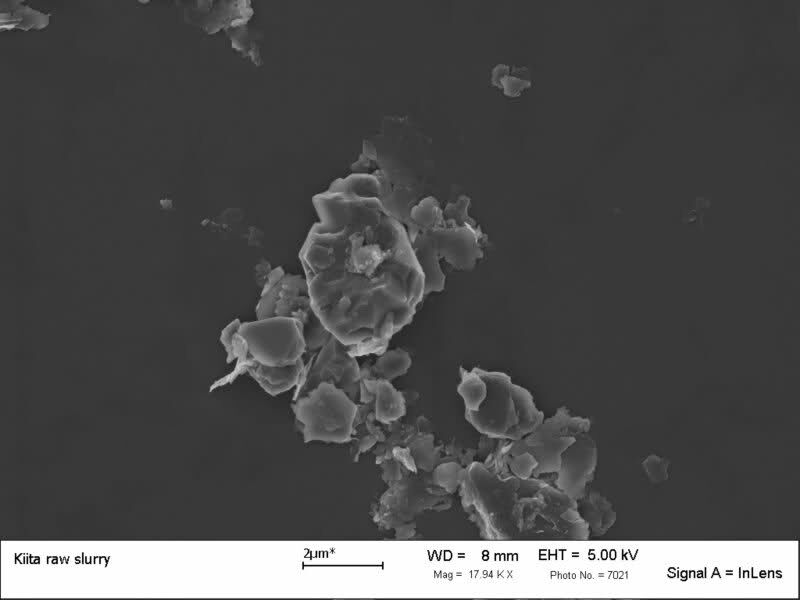
Pure slurry — fresh from stone |
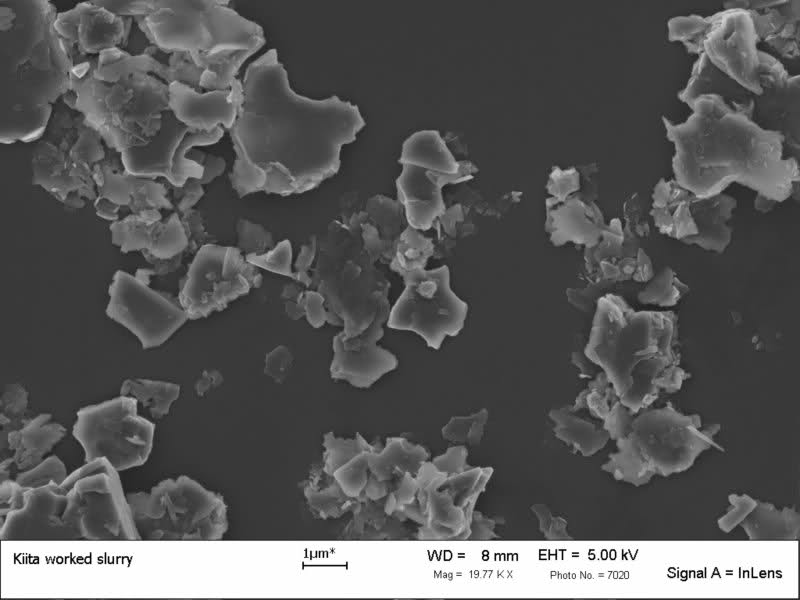
Worked slurry — after sharpening for a while |
Why Hardness is the Only Number That Matters
As you can see — it is impossible to answer what grit your Jnat is, because Jnats do not have standardized grit !!! The whole concept of "grit number" does not translate to natural finishing stones.
When I started JNS I wanted to try to rate stones by hardness, fineness and speed separately. I later discovered that all three of these things fall under hardness — hardness is the most important thing to look for, and the other two properties follow from it. So you will only see a level of hardness listed with any stone on my website.
Things are not always so simple though :) There are some exceptions. Some stones have more speed than others at the same hardness level. Some super hard Suita stones can be quite coarse — but they also release slurry much quicker than finer stones. The Su (holes) in Suita hold extra slurry and contribute to their faster cutting at any hardness level.
Speed and fineness are both real things that differ between stones — but they both come from hardness. A harder stone is always finer and slower. A softer stone is always faster and coarser. Within the same level there can be variation, which is why I test every stone individually and describe the cutting character in the product listing.
Practical Takeaway
- Do not ask what grit a Jnat is. It does not have one. It has a hardness level. That is the number you need.
- Harder = finer + slower. Always. A Lv 5 stone is always finer than a Lv 2 stone — but it is also much slower and needs more technique.
- Surface smoothness matters as much as hardness. A very hard stone with a rough surface gives a coarser finish than a softer stone with a smooth surface. Always flatten and smooth your stone before using it as a finisher.
- Work your slurry. Fresh slurry is coarser. As you work it, the flakes get thinner and the finish gets finer. This is the progression that makes Jnats special — you get a huge range of fineness from one stone just by managing your slurry.
- Hard stones need nagura. On a hard Lv 4+ stone, the stone does not release slurry on its own fast enough for efficient sharpening. Use a nagura to build slurry, then work it down. See the Naguras page and Diamond Plates vs Naguras.
Hope it helps to understand more and how to use Japanese natural finishers :)