

 Euro (EUR)
 DKK (DKK)
 AUD (AUD)
 CAD (CAD)
 UK (GBP)
 Chinese Yuan (CNY)
 Hong Kong Dollar (HKD)
 Swedish Krona (SEK)
 South African Rand (ZAR)
 Norwegian Krone (NOK)
 Israeli New Sheqel (ILS)
 Brazilian real (BRL)
 United Arab Emirates dirham (AED)
 Swiss franc (CHF)
Written by Maksim
This guide is for knives and razors. Read it before your first session with a natural stone. It will save you a lot of frustration. I will keep adding to it as questions come in :)
A basic natural stone session setup: stone, nagura, water, clean cloth.
Water
Japanese natural stones are water stones. Never use oil on them. Oil clogs the pores and kills the stone permanently !!!
Most natural stones do not need soaking. Just splash water on the surface before you start. Some softer stones benefit from a short soak of 5-10 minutes but do not leave them soaking for hours. It is not necessary and can weaken softer stones over time.
During sharpening, add a few drops of water when the slurry gets too thick or starts to dry out. Do not flood the stone with water. You want slurry, not a river. The right amount of water comes with practice. On very hard stones for razor finishing it can be good to do the very last few strokes with only plain water and no slurry at all.
Always rinse your knife or razor well with clean water before and after sharpening. Rinse the stone too.
Slurry: The Most Important Thing
On Japanese natural stones, the slurry does the work. Not the stone surface itself. The slurry. This is the most important thing to understand about Jnats and most people who have trouble with them do not understand this.
On softer stones the slurry builds up naturally from sharpening. On harder stones you need to help it along with a nagura. If you are getting no results from a hard stone. Most likely you have no slurry or not enough. Do not press harder !!! Use a nagura, make some slurry, then try again.
As slurry builds up it gets finer and finer. This is the progression. You can add a fresh nagura touch to refresh the cutting action, or wipe some slurry off and add water to make the stone act finer. You control the whole range just by managing your slurry. This is why experienced users prefer Jnats over fixed-grit synthetics.
Flattening
Natural stones dish slower than synthetics but they still need to be flattened occasionally. A dished stone gives you an uneven bevel and you will not be able to get a consistent edge on it.
Use a diamond plate (Atoma 140 or 400) or wet/dry sandpaper on a flat surface to flatten. After flattening with a diamond plate or sandpaper, always do a final smoothing pass with another natural stone or a nagura the scratches from the diamond plate are too coarse for finishing and need to be smoothed out. Tomo nagura (a piece of the same stone) works perfectly for this.
For knives
You can flatten with Atoma 140 or 400 and then smooth with a tomo nagura or any softer natural stone. For knives the surface does not need to be perfectly mirror smooth. A slightly textured surface from the Atoma is fine as long as it is flat.
For razors
For razor stones the surface needs to be as smooth as possible after flattening !!! Scratches on the stone surface will transfer to the razor bevel. Always finish the flattening with a tomo nagura or a softer natural stone after the diamond plate. Take your time with this step.
Video: How to flatten and smooth a natural stone with Atoma
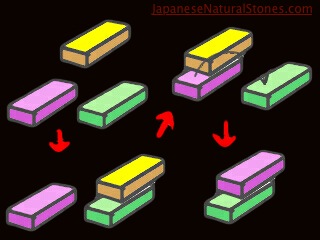
3 stone flattening is most recommended flattening system for Jnats
Nagura Tips
A few practical tips for using nagura that I do not see explained anywhere else:
- Make grooves in your nagura. Take a diamond plate or the corner of a hard stone and scratch a few grooves across the face of your nagura. These grooves help the nagura release slurry much faster and also stop the nagura from sticking to the stone surface. Do this on all your naguras. You will notice the difference immediately.
- Use nagura on hard stones for knives too. Many people think nagura is only for razors. Not true. On a hard Lv 4+ knife stone a Toma or Botan nagura will speed up the process a lot and give you better kasumi results on the jigane.
- Start fresh slurry for the final passes. Wipe the old slurry off, rinse the stone, and make a small fresh batch of slurry with a finer nagura for the last few strokes. This gives you the cleanest finish.
Grooves scratched into a nagura: this helps release slurry much faster.
Finger Stones
Finger stones (uchigomori, narutaki) are small flat pieces of natural stone used to polish softer clading for the hazy finish by. Held between the fingers and rubbed directly on the blade surface.
- Soft finger stones (uchigomori) for the soft iron jigane. These give the beautiful kasumi haze on the cladding.
- Harder finger stones for the hard steel (hagane). The very edge area or more clearer finish. On mono-steel or honyaki knives, softer stones are usually better.
See the dedicated Finger-stones How To page for a full guide with video.
Finger stone technique. Held between fingers, rubbed directly on the jigane.
Storage & Care
- No freezing temperatures. Do not leave your stone in a place that goes below 0°C (32°F). Water inside the stone expands when it freezes and cracks the stone. This also means do not leave a soaked stone outside on a cold night !!!
- No direct sunlight. Direct sun dries the stone very fast and can cause cracks. Keep stones away from windows.
- Lacquer the sides and bottom. Use a wood lacquer or urushi lacquer on the sides and bottom of the stone to seal it and reinforce it against cracks. Do not lacquer the sharpening surface.
- Cracks. If your stone has a crack, stop it immediately with super glue (cyanoacrylate). Thin super glue wicks into the crack perfectly. Let it cure fully before using the stone again. For bigger cracks or thin stones. Glue the stone to a wooden base. This prevents the crack from getting wider during use.
- Thin stones. Always glue thin stones to a wooden base before using them. A thin stone without a base will flex and eventually crack.
- Let it dry before storing. After use, rinse the stone and leave it to air dry completely before putting it away. Storing a wet stone in a closed box can cause problems over time.
Quick Reference: Do's and Don'ts
|
✅ Do
|
❌ Don't
|
That is it for now :) If you have a problem with your stone that is not covered here, message me on WhatsApp and I will help.
In the shop
- All Japanese natural stones → Japanese Natural Stones
- Naguras → Finger Stones and Naguras
- Synthetic stones → Synthetic Stones