
Written by Maksim
This page explains the terms you will see in every stone listing on JNS — colors, patterns, strata names, and knife/steel terms. I added photos of the most common appearances so you know what to look for when buying a stone.
Colors & Appearance
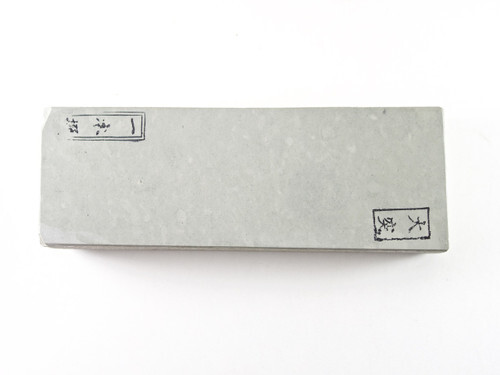
Asagi 浅葱
Pronunciation: ah-sah-ghee | Meaning: pale blue-green
The most common Nakayama stone color — a pale grey-blue. Asagi covers a wide range of actual shades from light silver-grey to deeper steel blue. Most hard Nakayama stones are Asagi. Do not assume color tells you anything about hardness — there are very soft Asagi and very hard Asagi. The hardest and finest Nakayama stones for razors are usually Asagi.
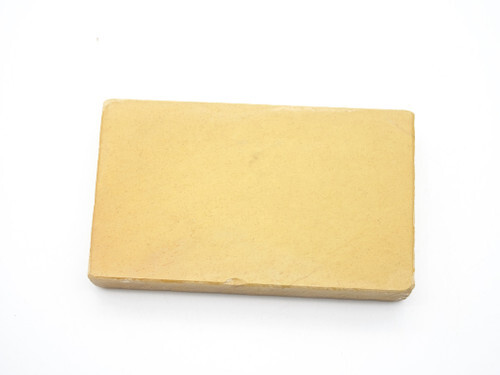
Kiita 黄板
Pronunciation: kee-ee-tah | Meaning: yellow stone
Yellow Nakayama stones — the most popular and sought after color. People love Kiita because you can easily see the swarf during sharpening. Shades range from pale cream-yellow to deep golden yellow.
Super hard Nakayama Kiita is extremely fine and sells for very high prices. But as Iwasaki-san showed in his own experiments — there is no difference in performance between a hard Kiita and a hard gray Asagi !!! Hard Kiita is expensive because it is almost gone, not because it is better. There are also many soft Kiita stones that are not useful for razors at all — hardness matters more than color always.
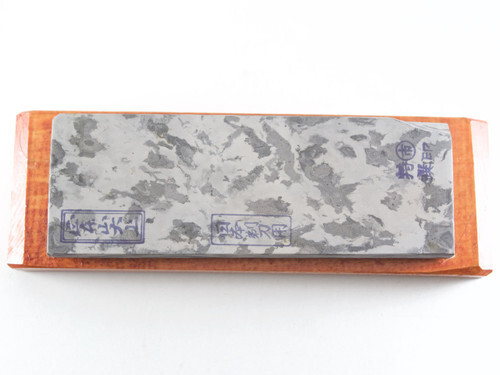
Karasu 烏
Pronunciation: kah-rah-soo | Meaning: crow (black)
Dark black areas or spots in the stone — named after the crow for the black color. The most sought after Karasu are in hard Asagi stones from Nakayama or Ozuku — these are extremely popular for razors and very rare. Karasu can also appear in softer Suita stones.
Karasu is rare and expensive. A hard Karasu Asagi Nakayama is one of the most collectible Jnats there is.
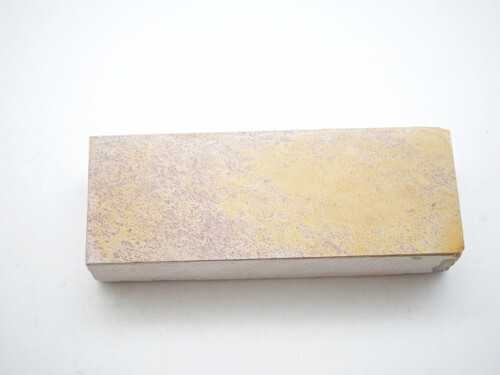
Renge 蓮華
Pronunciation: ren-geh | Meaning: lotus flower
A lotus flower-like pattern — often pink to purplish color with black. One of the most beautiful patterns a Jnat can have. Renge is only found in Suita strata stones. It does not add extra cutting ability but it makes the stone very desirable and expensive. A Suita Renge stone in the right hardness range can be a fantastic performer and a beautiful object at the same time.
Nashiji 梨子地
Pronunciation: nah-shee-jee | Meaning: pear skin
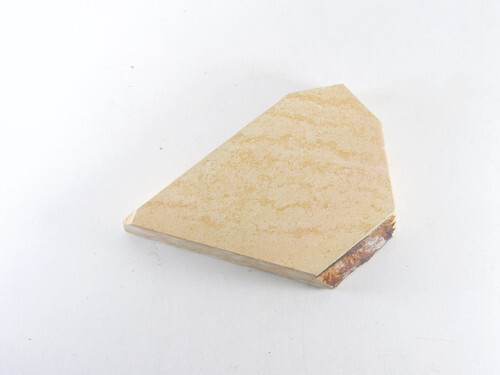
Small scattered dots on the stone surface — white, orange, yellow or even black. Named for the dotted texture of pear skin. Nashiji is a common appearance feature on Kiita stones especially (Nakayama Kiita Nashiji is a classic combination). The dots are cosmetic — they do not affect performance.
Habutae 羽二重
Pronunciation: hah-boo-tah-eh | Meaning: rice cake (silky white)
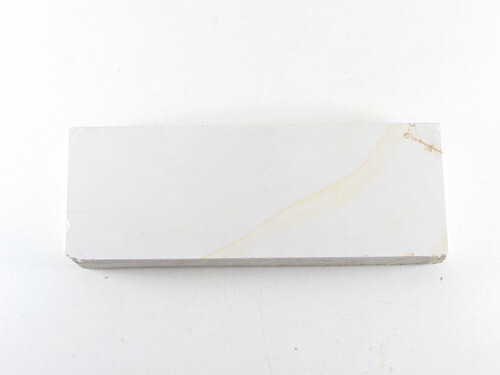
Almost pure white stone — very rare. Usually a Shiro (white) Suita. One of the rarest color variations of natural stones. Very beautiful and often collectible. As always — hardness and performance matter more than the color, but these are special stones.
Kan 環
Pronunciation: kahn | Meaning: rings
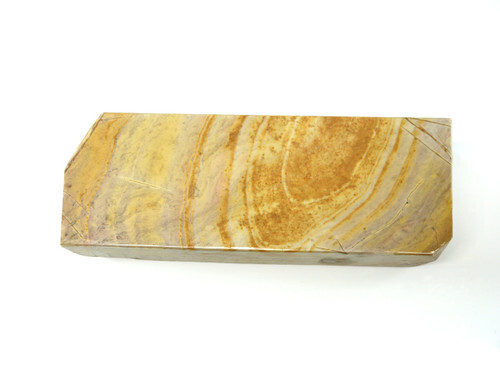
Ring patterns that appear where different geological strata meet inside the stone. Some can be incredibly beautiful — the famous "Nakayama Rainbow" is an example with multiple colored rings across the stone face. Kan is purely cosmetic but when it looks good it really looks good :)
Goma 胡麻
Pronunciation: go-mah | Meaning: sesame seeds
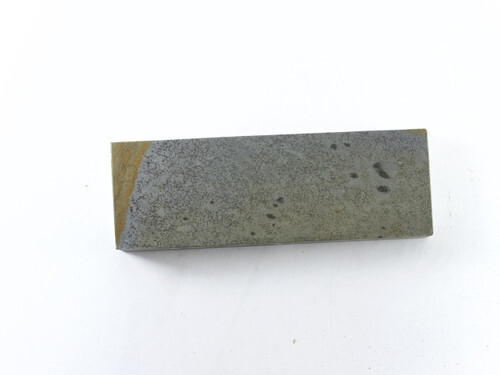
Small black spots scattered across the stone surface — named for sesame seeds. Goma spots can be either soft or hard. Hard Goma can scratch soft iron (jigane) if used without slurry — but with nagura and slurry they are not a problem and actually make the stone faster. Hard Goma stones work very well for Honyaki knives. Soft Goma does not affect sharpening at all. Usually found on Asagi stones but can appear on others too.
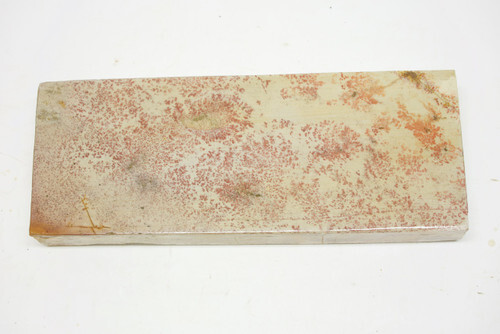
Momiji 紅葉
Pronunciation: mo-mee-jee | Meaning: maple leaves
A large Renge-like pattern that looks like maple leaves — only found in Suita strata. Similar to Renge but with larger, more irregular shapes. Momiji stones are beautiful and relatively rare. Like Renge, the pattern is purely cosmetic and does not change sharpening performance — but it does make the stone very desirable.
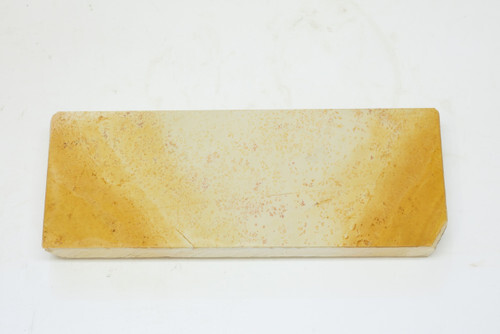
Su Nashi 巣無し
Pronunciation: soo nah-shee | Meaning: no holes
A Suita stone without the typical Su holes. Su Nashi Suita stones tend to be harder than Suita stones with holes — the density is higher because there are no air pockets. This makes them excellent for razors and hard tool work where you want all the fineness of Suita but with more resistance and a finer surface. Rare and sought after.
Strata — Geological Layers
Strata refers to which geological layer the stone came from. Softer layers sit higher up, harder layers sit deeper. The strata name tells you roughly where in the mountain the stone was cut. Like mine names — strata alone does not guarantee performance. Always test the stone.
| Strata Kanji | Notes |
|---|---|
| Suita 巣板 | Contains Su (holes). Often faster cutting. Where Renge and Karasu patterns are found. Used heavily for knives and tools. |
| Tomae 戸前 | Most common strata — 48 sub-levels. Wide range of hardness. Most Awasedo come from Tomae. |
| Namito 並砥 | Medium layer. 8 sub-levels. Good range of knife and razor stones found here. |
| Aisa 合砥 | Upper layer. Often harder and finer. Sits between softer and harder zones. |
| Tenjyou 天上 | Ceiling layer — very soft and very fine. Rare. Tenjyou Suita is one of the rarest strata of all. Name also used for the finest Asano nagura. |
Knife & Steel Terms
These are the terms you will see in knife listings and in discussions about sharpening technique on natural stones.
Hagane 鋼
The hard steel cutting core of a clad knife or razor. White steel, blue steel, Tamahagane etc. This is the part that actually holds the edge. On natural stones, hagane takes a polish beautifully.
Jigane 地鉄
The soft iron cladding around the hard steel core. On a kasumi finish knife the jigane gets the hazy polish. Be careful with hard stones on jigane — always use slurry and light pressure or you will scratch it.
Kasumi 霞
The hazy mist-like polish on the jigane (soft iron) of a knife. One of the most beautiful results of Jnat sharpening — impossible to achieve with synthetic stones. See the Kasumi on Hard Jnats page.
Kurouchi 黒打ち
The black forge scale finish left on the blade from forging — unpolished, rustic. Many Munetoshi and Tanuki knives come in kurouchi.
Honyaki 本焼
A mono-steel blade — no soft iron cladding. Harder to make, harder to sharpen, maximum performance. Differentially hardened. Usually water quenched. The blacksmith paints the spine of the blade with a special clay mixture before quenching it in water.
San Mai 三枚
Three-layer construction — hard steel core sandwiched between two layers of softer iron or steel. The most common construction for Japanese kitchen knives. The soft cladding protects the hard core.
Omote 表
The front face of a kamisori razor.
Ura 裏
The back face of single beveled knives. Large radius hollow grind. Also used to describe the hollow on the flat back of a Kamisori or chisel.
Stone Terms
Toishi 砥石
Whetstone / sharpening stone. General term in Japanese for any sharpening stone. Tennen Toishi (天然砥石) = natural whetstone.
Awasedo 合砥
Finishing / polishing stone. The term for the final natural stone in a sharpening progression. All Jnats used for polishing and finishing are Awasedo.
Tomo Nagura 共名倉
A nagura made from the same type of stone as the main stone — used to raise slurry from it or to smooth the surface after flattening. The most compatible nagura for any stone because the particles match.
Koppa 木端
Small offcut piece of natural stone — leftover from cutting a larger stone. Koppa stones are budget friendly and a great way to try natural stones for the first time. Perfect for narrow blades, razors and pocket knives.
Uchigomori 内曇
A very soft, very fine finishing stone from the Tenjyou Suita strata — traditionally used in Japanese sword polishing. Also used as finger stones for polishing jigane and ura of knives and razors. Expensive due to scarcity.
That is it for now :) If you see a term in a stone listing that is not here, just message me on WhatsApp and I will add it.