

 Euro (EUR)
 DKK (DKK)
 USA (USD)
 CAD (CAD)
 UK (GBP)
 Chinese Yuan (CNY)
 Hong Kong Dollar (HKD)
 Swedish Krona (SEK)
 South African Rand (ZAR)
 Norwegian Krone (NOK)
 Israeli New Sheqel (ILS)
 Brazilian real (BRL)
 United Arab Emirates dirham (AED)
 Swiss franc (CHF)
Written by Maksim
Mikawa Shiro Nagura — what they are, how they work, and when to use them
Nagura are small stones you rub on your main sharpening stone to create slurry.
This page is about Mikawa Shiro Nagura (三河白名倉) — the certified Asano nagura from Aichi prefecture in Japan. These are the ones I sell and the ones I recommend. Do not buy uncertified nagura sold cheaply online — quality is inconsistent and hard spots can scratch your stone or blade !!!
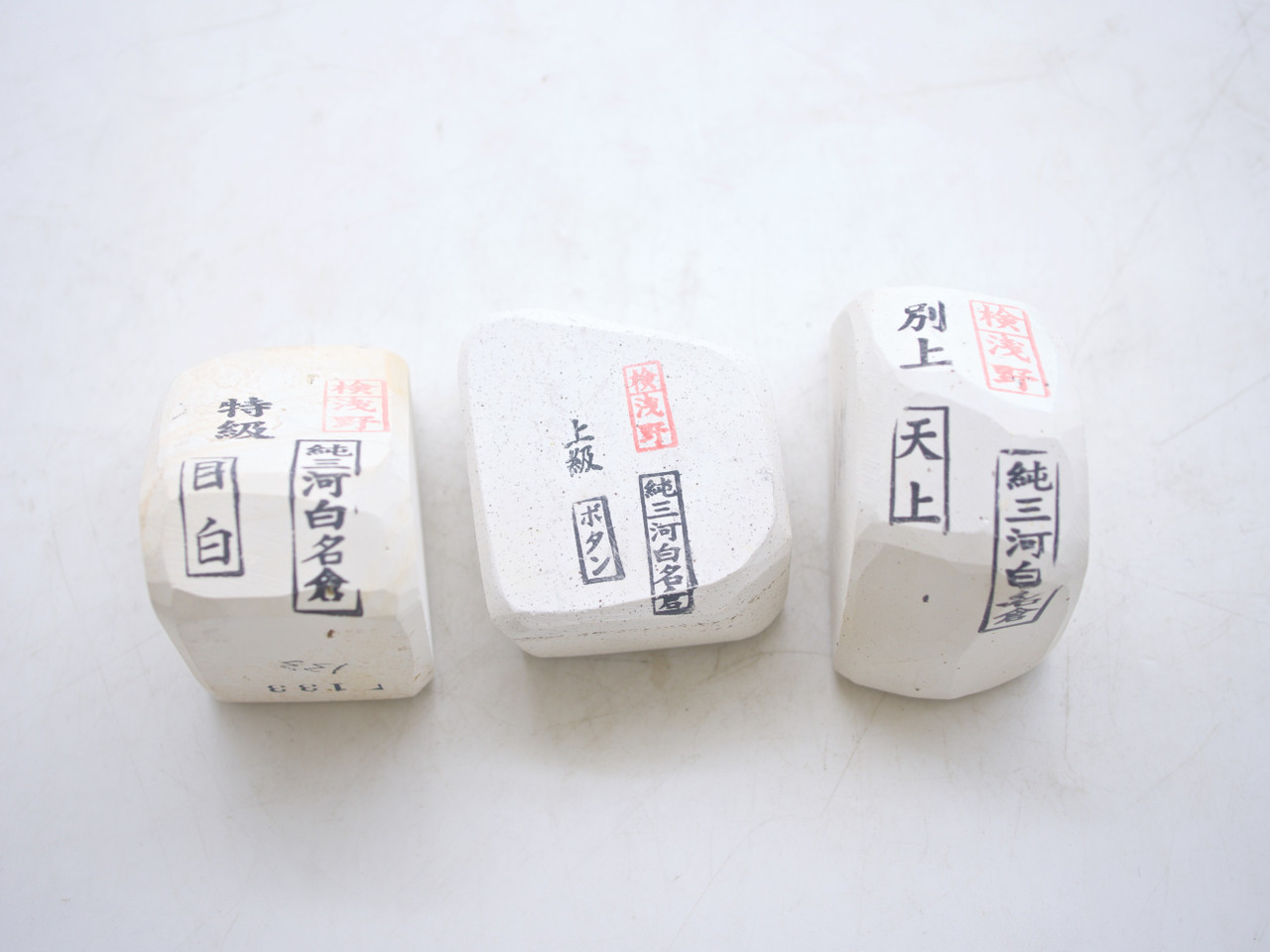
Asano Nagura set — Botan, Tenjyou and Mejiro with the Asano quality stamp.
Where Nagura Come From
Mikawa Shiro Nagura come from the Mikawa Nagura mine in Aichi prefecture, Japan. The mine has 12 layers of stone but only 8 can be used for sharpening — and of those 8, only 4 are commonly used and sold: Botan, Tenjyou, Mejiro and Koma. Each layer has its own fineness and characteristics.
The most important thing when buying nagura is the Asano stamp. Asano is the company that certified and quality-controlled the nagura from this mine for many years. The stamp guarantees authenticity and consistent quality. Many sellers offer uncertified nagura at lower prices — they look similar but quality varies wildly and hard spots can scratch your stone or blade. Only buy stamped Asano nagura !!!
特級上 — Superior high grade | 特級 — High grade | 別上 — Superior selected grade | 上級 — Superior grade
The grade refers to consistency and quality within the same strata. For sharpening purposes the difference is small. For collection purposes the higher grades are more sought after.
The 4 Nagura Types
From coarsest to finest: Botan → Tenjyou → Mejiro → Koma
The coarsest and fastest of the four. Builds slurry very quickly on even the hardest stones. This is the one to start with when you need to establish slurry on a hard Jnat. For knife sharpening on Lv 3+ stones, Botan is often all you need. For razor work it is the first step in the nagura progression. Also very useful for cleaning the surface of a Jnat between sessions.
Medium fineness. Transition stone after Botan slurry has done its work. For knife sharpening on hard stones, Tenjyou with Botan is a complete setup. For razors, Tenjyou comes after Botan and prepares the surface for the finer Mejiro stage. Good all-around nagura for experienced users.
Fine. For knife sharpening with harder stones Mejiro gives excellent results on the edge and jigane. For razors it is the pre-finishing stage on Lv 4–4.5 stones. Mejiro leaves a noticeably finer result than Tenjyou and is the point where you start to see real razor-grade refinement. Koma is most fine in grit but Botan, Tenjyou and Mejiro are all fine enough for knife sharpening and there is not much difference between them for knife work !!!
The finest of all Mikawa Shiro Nagura. Used for the pre-finishing stage on Lv 4.5–5 razor stones and for very fine knife work. Koma is the point where you can really feel the difference in edge quality compared to stopping at Mejiro.
Koma is extremely rare and expensive because the raw rock that produces quality Koma from the mine is nearly depleted. If you see Koma being sold at low prices without the Asano stamp — it is almost certainly not genuine Koma. For knife sharpening you do not need Koma. For serious razor work it is worth having one good piece.
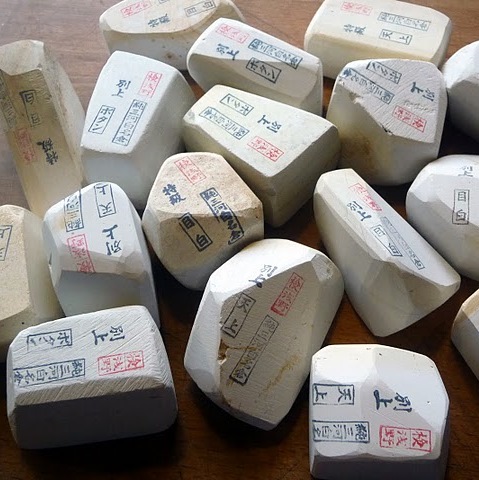
Asano Nagura stones — Botan, Tenjyou, Mejiro and Koma with the Asano quality stamp.
For knives
For most knife sharpening on Lv 3+ stones, a Botan or Tenjyou nagura is enough. Build up slurry with the Botan first, sharpen, then rinse and use a light Mejiro touch for the final passes if you want a cleaner kasumi. You do not need a full progression for knife work — Botan alone makes a huge difference on hard knife stones.
For razors
Razor work uses a progression through all the nagura types. Each one refines the slurry from the previous step:
For more detail on how to use nagura in a razor progression see the Razors on Jnat page.
Video — Honing Kamisori with Asano Naguras
Full kamisori honing session using Asano Naguras on Nakayama and Iwasaki stones — you can see the full nagura progression from Botan through to water-only finish.
Honing a Kamisori with Asano Naguras on Iwasaki and Nakayama stones
That is it :) If you have questions about which nagura is right for your stone and what you sharpen, just message me on WhatsApp.